


Raoul Heertje inspires young people with Freedom College: 'Get to know each other'
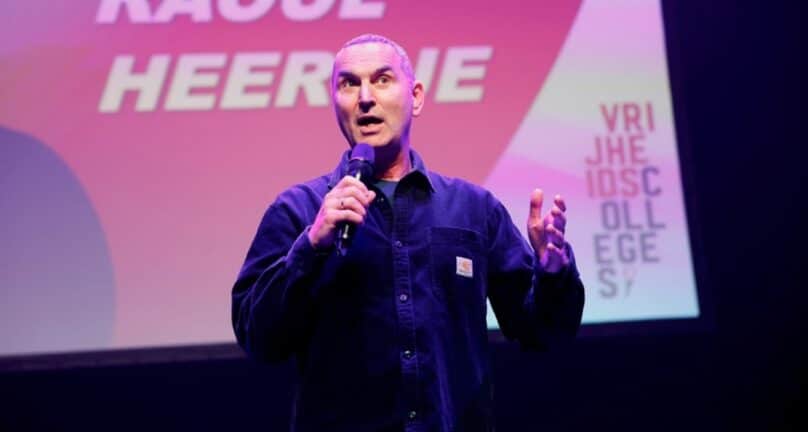
"I'm so happy to be here; there's such a great vibe here." Raoul Heertje glances at all the activity in the auditorium on Willem de Rijkelaan in Eindhoven. He's clearly looking forward to it.
On this sunny Monday morning, Heertje, a regular talk show host and known for the TV program "Dit was het nieuws" (This Was the News), will speak with around 120 students from various Summa programs about the Four Freedoms. Almost 80 years ago, former US President Franklin D. Roosevelt launched these four freedoms during his 1941 State of the Union address.
The four freedoms are:
– Freedom of expression
– Freedom of religion
– Freedom from want
– Freedom from fear
Young people reflect on the value of freedom
Raoul Heertje immediately gets a kick out of him: "When I see a very fat man eating a huge dessert, I can call him out on it and tell him he shouldn't. That it would be wiser to go for a walk. I can also explain to him that the taxpayer is footing the bill for healthcare." Raoul gets a good laugh, but he makes his point clear. "You can say whatever you want, but you don't have to."
Another one: "After one of my theater performances, a woman approached me. She was bothered by the fact that I was talking about autism in my performance. I hadn't said anything out of the ordinary about it, and yet it bothered her because her son was autistic. Because she shared this with me, we developed a mutual understanding. I would therefore like to invite you, if you have a difference of opinion, to always try to exchange ideas with each other."
How do you deal with extreme expressions?
Heertje also faced a fair number of questions from the audience: "Sometimes I'm at the pub with my friends, and I don't feel like getting into that discussion every time, for example, racist remarks are made. What's your position on this?" Raoul considers this comment for a moment before answering. "I would still say something about it. Listen carefully and try not to interrupt the other person with your own story. This gives them a chance to present their perspective. Then you give your perspective, and maybe there will be some common ground, or perhaps they'll be more willing to listen to you."
The situation at the family party where an aunt made discriminatory remarks also evokes a lot of familiarity. Raouls' advice: "Keep trying, and if it really doesn't help, maybe avoid the parties or the aunt in question."
Is there hope when you look at the current world stage?
"I'm Jewish, but not religious," Heertje explains. "I lived in Israel for about three years, and my perspective on the Palestinian issue slowly changed there." Raoul gets emotional when he hears about what's currently happening in Gaza. "Some people say I shouldn't use the word 'genocide.' But then what? In the Netherlands, we're good at derailing discussions by focusing on the word choice rather than the substance. I don't want to talk too much about Israel, even though that's what concerns me most."
Raoul presents a striking dilemma: “Two fathers, one Israeli and the other Palestinian, have both lost their daughters. One to a sniper, the other to an attack. Both are committed to ending the war and starting dialogue. That gives me comfort, that offers hope. If those people there can do that, what do I have to complain and whine about?”
Political opponents
"Suppose, hypothetically, I have a friend who votes for the PVV (Party for Freedom). I'd start a conversation with him to explain why I think that's a bad idea. Specifically, because that party excludes and offends people and insults women who wear headscarves." The students present burst into loud applause.
Raoul concludes his lecture: “I am regularly invited as a guest on talk shows. Tonight (May 12, ed.) I will be on Bar Laat with the State Secretary for Youth, Prevention and Sport. That is not because I am so well-informed on the subject matter, but I always manage to bluff my way through. I am the kind of guy who doesn’t mince words. Don’t let anyone tell you that you know little when you are young. The older I get, the more aware I become of what I don’t know. That makes me always want to hear the other side of the story. Reading the newspaper or watching the news doesn’t help you understand the other person better. Go to the pub, to the theater, or to a festival. Meet people, talk to each other, and get to know one another. That is my advice.”