Production Technician (BBL)
Expertises
Construction worker
The foundation of a sturdy structure; as a construction worker, you are going to build it.
A structure makes a building stable. You sometimes work with heavy materials, such as metal plates and profiles. As a construction worker, you learn to do this safely, accurately, and properly.
Enjoy working with your hands, but also with machines. As a production technician in construction, you'll learn to do this safely, accurately, and efficiently. A structure makes a building stable. You'll sometimes work with heavy materials, such as metal plates and profiles.
During your training, you'll learn to work with various sheet metal and construction machines. Besides operating them, you'll also learn the processing techniques used in companies, such as separating, machining, forming, and assembling. Once you've mastered the machines and techniques, you'll produce workpieces independently, paying close attention to errors and deviations.
Your manager is your mentor. If you're willing to listen, you can learn a lot from them. For example, always use the correct safety equipment. If you discover unsafe situations, report them immediately.
Lasser
Learn how to make welding a real craft
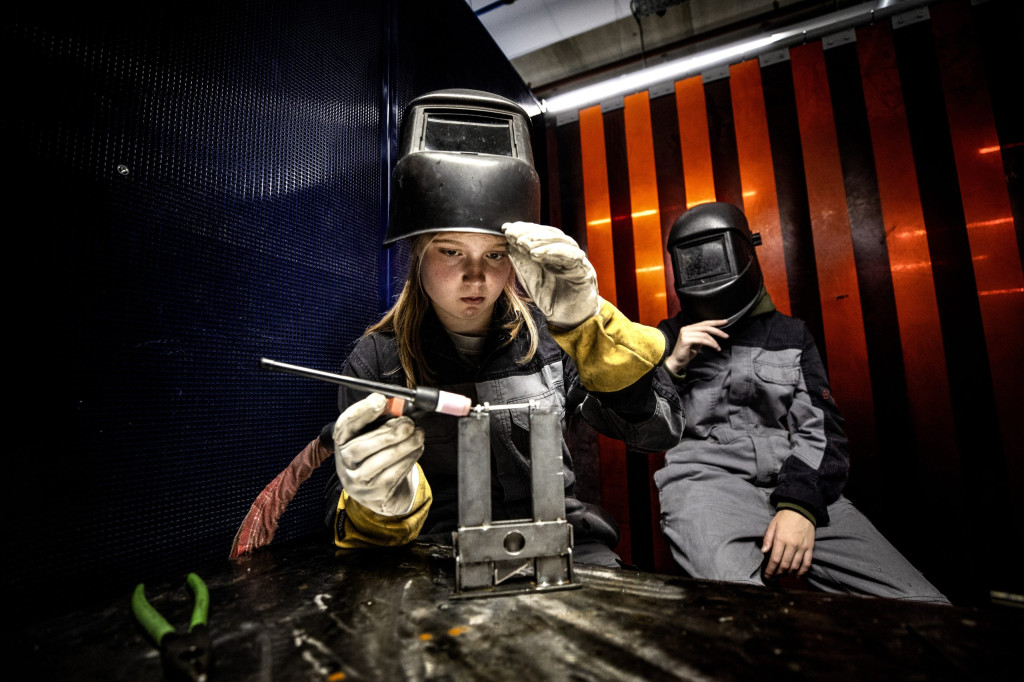
As a basic welder, you work with various welding machines, but primarily with your hands. You create strong connections between two pieces of metal. You receive assignments from your supervisor and carry them out independently. You read which weld to make on a drawing. You work accurately to deliver true craftsmanship.
At school, you will learn about various welding machines and techniques. As a basic welder, you perform non-certified welding work. This means that your welding work does not have to meet specific safety and quality requirements. If you do wish to do so, you can progress to the Level 3 All-round Production Technician course after or during this training.
Sheet metal worker
Turn a plate into a beautiful piece of craftsmanship
As a sheet metal worker, you often make an important construction part of a product: a piece of metal with exactly the right angles, holes and edges.
When you make something, it has to be right. That's why the sheet metal worker profession is a good fit for you. You often create a key structural component of a product: a piece of metal with precisely the right angles, holes, and edges.
At school, you'll learn to work with various sheet metal and construction machines. You'll learn a wide variety of sheet metal processing techniques. You'll also receive lessons in welding, reading drawings, and punching out sheet metal. The assignments you'll receive at school are the same as those you'll receive on the job, training you to become a true professional.
Working safely is crucial. You always use the required safety equipment and ensure your colleagues and classmates do the same. Rules are there for a reason; together you prevent accidents. In your work, you support the all-around sheet metal worker. They want the same thing as you: to deliver beautiful craftsmanship every time.
Machinist
Turning, drilling, milling, grinding: you can do it all with ease!
As a machinist, you create a high-quality finished product from a piece of aluminum, steel, cast iron, or plastic. For example, the axle of a car or a machine part. You use various techniques for this, such as turning, drilling, and milling.
Based on a technical drawing, you will work independently on a CNC machine. You clamp the workpiece and set up the machine. After machining, you measure and check whether the product exactly meets the requirements on the drawing.
At school, you'll learn various machining techniques and how to read drawings. You'll also learn all about materials, tools, and working with (CNC) machines. You'll learn how to adjust, set up, and maintain them, so you can work safely after completing your training.
More information.
What are you becoming?
As a welding production technician, you can work for example at construction companies, welding companies, machine and equipment manufacturing companies, and the metal products industry.
As a structural worker, you can work for example at construction companies, companies that manufacture structural components, companies in the machine and equipment manufacturing industry, or the transport equipment industry.
As a sheet metal worker, you can, for example, work in the metal products industry (large and small) or sheet metal companies.
As a machinist, you can, for example, work for companies in the steel, aluminium, or plastics industries, among others.
You can, of course, also progress to the Level 3 All-round Production Technician course.
What does your education look like?
You'll attend theory classes at school one day a week. You'll also work in the field at your training company.
Education and Examination Regulations (OER)
In the Education and Examination Regulations (OER) of a study program, you can read what you will be doing in which period, how much time is spent on this, and an overview of the exams that will be administered. Find the OER for your study program here.
Search by your Crebo number (see the box on the right of this page) to view the OER for the current academic year. This will give you a general idea of what's expected of you when you start the program. The OER for the upcoming academic year will be available in July.
Additional guidance with the bbl-plus program
Could you use some extra guidance with practical learning? Then the BBL-plus track is for you:
- Individual learning path with a lot of personal attention
- Practical learning in the high-tech practice area of the Brainport Industries Campus
Statutory tuition fees
The statutory tuition fee for the 2027-2028 academic year amounts to 323 euros.
Other costs
NIL welding diplomas
Part of this training is obtaining two NIL2 welding certificates. The cost of these welding exams is approximately €150 per exam. Training for these exams takes place on-site or can be outsourced. For more information about the options and costs, please contact 040 269 4450.
Learning resources
For an estimate of the other costs for this program, visit mbowebshop.nl . Every year, the costs of learning materials for the following school year are announced there no later than July 1st.
Laptop
For many study programs, you cannot do without a computer as a student. Check the overview to see if this applies to your program and download the correct specifications.
Elective courses
During your studies, you choose one or more electives to specialize or to broaden your education. Examples include entrepreneurship, leadership, programming, or a language. Throughout your studies, you will receive more information about the electives you can take. You complete each elective with an exam. Read more about electives.
Study in figures
Study in Figures provides clear information about this program and job market opportunities. Would you like to know more about these figures? Then check out this explanation.
What prior education do you need?
For basic vocational training (level 2) you must meet one of the following conditions:
- You have a diploma in pre-vocational secondary education (VMBO) with a basic vocational track, a pre-vocational secondary education (VMBO) with a framework vocational track, a pre-vocational secondary education (VMBO) with a theoretical track, or a mixed track.
- You have an (older) diploma from lbo, vbo, mavo or mavo-vbo.
- You have an entry-level training or basic vocational training diploma (level 2).
- You have proof that you have successfully completed the first three years of pre-university or senior general secondary education (havo) or pre-university education (vwo). This proof is recognized by the government.
Work at a recognized training company
Before you start the program, you will search for a work-study company in the field yourself. You can find a list of recognized training companies via Stagemarkt .
On the website of SBB (Cooperation Organisation for Vocational Education and the Business Community), you will find information about the labour market, internships, and professions. SBB is committed to providing students with the best practical training with a view to employment.
On the Brainport Industries College website, you can watch career videos, find internships and apprenticeships, and register for a Tech event.
Can I contact a teacher?
Teachers know what's going on at school. Feel free to ask your questions using the contact information below:
WhatsApp
Contact Paul van Mierlo
E-mail
Contact Paul van Mierlo
It is also possible to attend a shadowing day, guided tour, or open day. You can find all activities in our calendar.
Industry news


Need help with your study choice?
We are ready for you!
Are you unsure about which study program to choose, or do you have no idea yet which direction you want to take? Then take the study choice test and talk to our study choice coaches. We are happy to help you on your way.