


Contact lens specialist
More information.
What is the difference between the 1-year and 2-year tracks?
In the 1-year track, you take CL1 and CL2. This allows you to specialize in soft lenses. In the 2-year track, you take CL1, CL2, CL3, and CL4 and complete the full training to become a Contact Lens Specialist.
What can I do after the 1-year program?
After the one-year program, you will be able to fit and assess soft contact lenses. You will also have acquired the basic knowledge and practical skills to work more effectively in a contact lens practice.
What do I learn in CL1, CL2, CL3, and CL4?
CL1 – Basic knowledge of contact lenses
You will learn the basics of contact lenses and contact lens practice. Think of:
- History form and customer information
- Anatomy in physiology
- Ethical conduct and advice
- Eccentricity
- Conversation and communication
- Assessing deviations
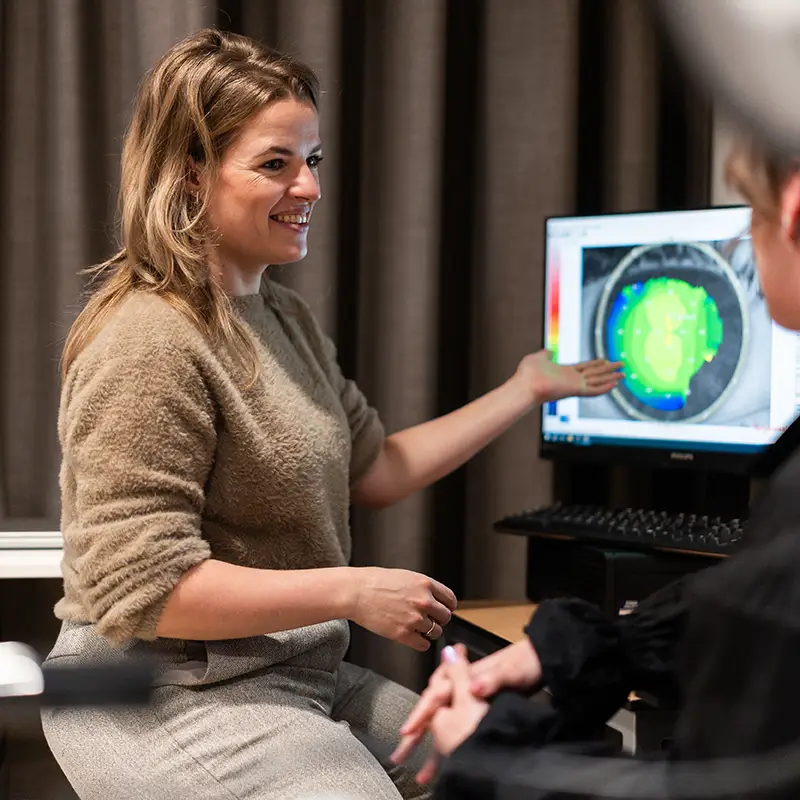
- Slit lamp examination
- topography
After this section, you will be able to collect information from a customer and provide support in the contact lens practice.
CL2 – Soft lenses
You will learn, among other things:
- Fitting soft lenses
- Checking and assessing soft contact lens data
- Maintenance of various types of lenses (solutions)
- Toric soft contact lenses
After this module, you will be able to fit and assess soft contact lenses. You can also complete this section with a Soft Lens Expert diploma (1-year program).
CL3 – Hard lenses
You will learn, among other things:
- Aspherical contact lenses
- Checking and assessing hard lens data
- Cardigan selection
- Types of lenses and fittings
- Strengths and correction options
- Applicability of various lenses
After this section, you will be able to fit and assess a hard contact lens.
CL4 – Medical / special lenses
In this section, you delve into specialized topics, such as:
- Astigmatic corrections
- Keratoconus
- Ortho-K lenses
- Presbyopia and contact lenses
- Special applications
After this part, you will specialize in specialized and medical applications within contact lens care (2-year program) and receive the Contact Lens Specialist diploma.
On which day is the training?
The class day is Monday.
How many teaching days does the course have?
The program is structured into two (1-year track) or four components (2-year track): CL1, CL2, CL3, and CL4. Each component consists of 15 class days. You attend school 30 days per year.
Is the study program easy to combine with work?
Yes, the course is intended for people who already work in optics. However, you should take into account class days as well as time for self-study (8 hours per class day).
Who is this course intended for?
The course is intended for opticians who wish to further specialize in contact lenses.
What will this course offer me?
You further specialize in contact lenses, learn skills you can use immediately in practice, and become more versatile in the store or contact lens practice. Additionally, you develop your expertise in current topics such as myopia, orthokeratology, and specialist lenses, and expand your career advancement opportunities within the profession.
Are there any admission requirements?
To participate, you need an MBO-4 Optician diploma and work in an optical shop.
Can I take this course through my employer?
Yes, in many cases that is possible. Discuss this with your employer. There is also a separate page with more information for employers.
How much does this training cost?
For the 2026-2027 academic year, the costs, including readers and teaching materials, amount to a maximum of € 3400, -.
Summa training courses and teaching materials provided by Summa are exempt from VAT. Read more about training costs.
Are there any exam fees?
Yes. The exams are administered and billed separately by SOESV (exam provider). The costs as of January 2026 are:
- Theory exam: €224 excluding VAT
- Practical exam: €376 excluding VAT
Each module, modules 1 through 4, concludes with one theory exam and one practical exam. These exam fees therefore apply per module.
The theory exam takes place at an external location and can be scheduled independently. The practical exam takes place at the school location and is administered by two external assessors.
Which diploma or certificate will I receive?
Upon successful completion of the full training program, you will receive the Contact Lens Specialist industry diploma. For the 1-year program, you will receive the soft lenses certificate.
How do I sign up for the 1-year or 2-year program?
Would you like to follow the 1-year program? Then let us know you are interested by sending an email to Merel Groenen via mwt.groenen@summacollege.nl.
Would you like to follow the 2-year program? Then you can register via the registration button at the top right of this page.
What is the difference between the 1-year and 2-year tracks?
In the 1-year track, you take CL1 and CL2. This allows you to specialize in soft lenses. In the 2-year track, you take CL1, CL2, CL3, and CL4 and complete the full training to become a Contact Lens Specialist.
What can I do after the 1-year program?
After the one-year program, you will be able to fit and assess soft contact lenses. You will also have acquired the basic knowledge and practical skills to work more effectively in a contact lens practice.
What do I learn in CL1, CL2, CL3, and CL4?
CL1 – Basic knowledge of contact lenses
You will learn the basics of contact lenses and contact lens practice. Think of:
- History form and customer information
- Anatomy in physiology
- Ethical conduct and advice
- Eccentricity
- Conversation and communication
- Assessing deviations
- Slit lamp examination
- topography
After this section, you will be able to collect information from a customer and provide support in the contact lens practice.
CL2 – Soft lenses
You will learn, among other things:
- Fitting soft lenses
- Checking and assessing soft contact lens data
- Maintenance of various types of lenses (solutions)
- Toric soft contact lenses
After this module, you will be able to fit and assess soft contact lenses. You can also complete this section with a Soft Lens Expert diploma (1-year program).
CL3 – Hard lenses
You will learn, among other things:
- Aspherical contact lenses
- Checking and assessing hard lens data
- Cardigan selection
- Types of lenses and fittings
- Strengths and correction options
- Applicability of various lenses
After this section, you will be able to fit and assess a hard contact lens.
CL4 – Medical / special lenses
In this section, you delve into specialized topics, such as:
- Astigmatic corrections
- Keratoconus
- Ortho-K lenses
- Presbyopia and contact lenses
- Special applications
After this part, you will specialize in specialized and medical applications within contact lens care (2-year program) and receive the Contact Lens Specialist diploma.
On which day is the training?
The class day is Monday.
How many teaching days does the course have?
The program is structured into two (1-year track) or four components (2-year track): CL1, CL2, CL3, and CL4. Each component consists of 15 class days. You attend school 30 days per year.
Is the study program easy to combine with work?
Yes, the course is intended for people who already work in optics. However, you should take into account class days as well as time for self-study (8 hours per class day).
Who is this course intended for?
The course is intended for opticians who wish to further specialize in contact lenses.
What will this course offer me?
You further specialize in contact lenses, learn skills you can use immediately in practice, and become more versatile in the store or contact lens practice. Additionally, you develop your expertise in current topics such as myopia, orthokeratology, and specialist lenses, and expand your career advancement opportunities within the profession.
Are there any admission requirements?
To participate, you need an MBO-4 Optician diploma and work in an optical shop.
Can I take this course through my employer?
Yes, in many cases that is possible. Discuss this with your employer. There is also a separate page with more information for employers.
How much does this training cost?
For the 2026-2027 academic year, the costs, including readers and teaching materials, amount to a maximum of € 3400, -.
Summa training courses and teaching materials provided by Summa are exempt from VAT. Read more about training costs.
Are there any exam fees?
Yes. The exams are administered and billed separately by SOESV (exam provider). The costs as of January 2026 are:
- Theory exam: €224 excluding VAT
- Practical exam: €376 excluding VAT
Each module, modules 1 through 4, concludes with one theory exam and one practical exam. These exam fees therefore apply per module.
The theory exam takes place at an external location and can be scheduled independently. The practical exam takes place at the school location and is administered by two external assessors.
Which diploma or certificate will I receive?
Upon successful completion of the full training program, you will receive the Contact Lens Specialist industry diploma. For the 1-year program, you will receive the soft lenses certificate.
How do I sign up for the 1-year or 2-year program?
Would you like to follow the 1-year program? Then let us know you are interested by sending an email to Merel Groenen via mwt.groenen@summacollege.nl.
Would you like to follow the 2-year program? Then you can register via the registration button at the top right of this page.
My goal is that students
What do our customers and students say?
Also view this course
Call me
We will call you back as soon as possible!
"*" indicates required fields